
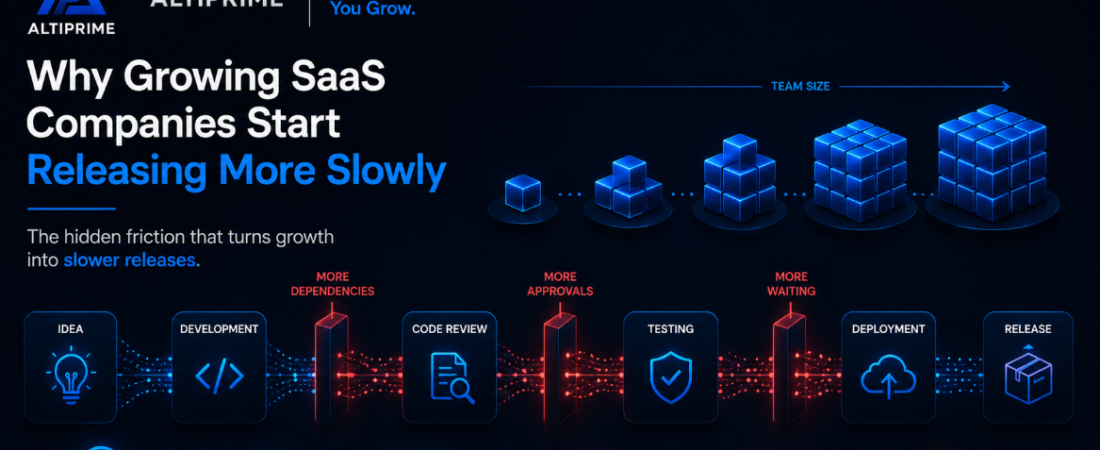
Growing SaaS companies expect release speed to increase as they scale.
More engineers.
More resources.
More experience.
More investment.
Yet many companies experience the opposite.
Releases become slower.
Deadlines slip.
Features take longer to reach customers.
Teams work harder but delivery slows down.
The assumption is usually that the engineering team needs more capacity.
In many cases, that is not the real problem.
Growth Creates Friction
As companies grow, complexity grows with them.
New teams are formed.
More systems are added.
More stakeholders become involved.
More approvals appear.
More dependencies are introduced.
Work no longer moves through a simple path.
It moves through a network of reviews, handoffs, meetings, testing stages, deployment requirements, and coordination points.
Each step adds a small amount of friction.
Individually, these delays may seem insignificant.
Together, they can dramatically slow delivery.
The Hidden Cost of Slow Releases
Slow releases affect more than engineering teams.
Customers wait longer for improvements.
Product teams wait longer for feedback.
Sales teams wait longer for capabilities they need to win opportunities.
Revenue opportunities move further into the future.
Competitive advantages take longer to reach the market.
What begins as a delivery problem eventually becomes a business problem.
Why Adding More Engineers Often Doesn’t Help
A common response to slower delivery is to increase headcount.
Sometimes this helps.
Often it does not.
When friction is the root cause, adding more people can introduce additional coordination requirements, more communication overhead, and more dependencies.
The system becomes larger while the underlying bottlenecks remain unchanged.
The result is a bigger team moving at the same speed—or sometimes even slower.
What Healthy SaaS Companies Do Differently
High-performing SaaS companies focus on the flow of work.
They look for delays between stages.
They identify unnecessary approvals.
They reduce dependency chains.
They simplify delivery processes.
They remove friction that prevents value from reaching customers quickly.
The objective is not simply to work harder.
The objective is to make work move more efficiently through the system.
Final Thought
Slow releases are rarely caused by a lack of effort.
Most teams are already working hard.
The real challenge is understanding where friction has accumulated as the company grows.
When that friction is removed, release speed improves, customers receive value sooner, and the business can move faster without increasing chaos.
Altiprime helps SaaS companies identify and resolve operational, architectural, and scalability bottlenecks before they become growth constraints.
Neil Altawil | Founder & CEO, Altiprime
LinkedIn:https://linkedin.com/in/neil-altawil