Growing SaaS companies rarely struggle because they lack software.
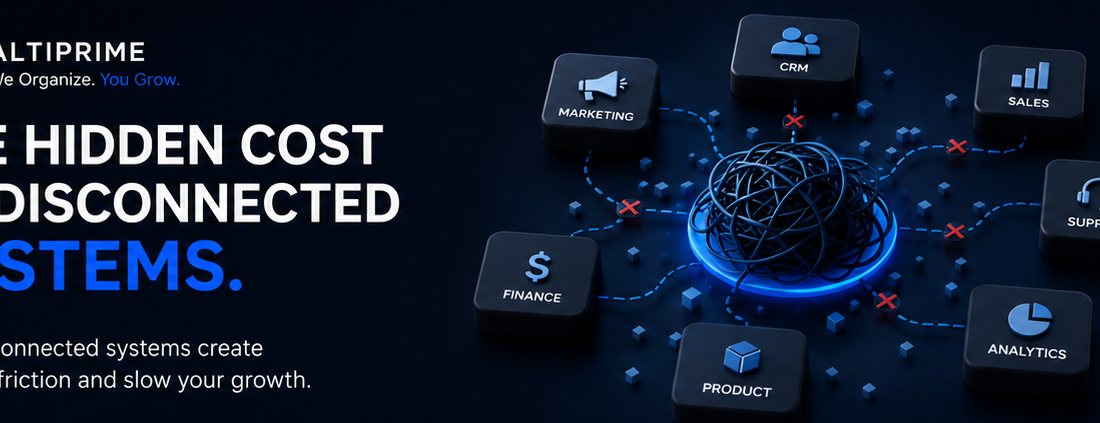
They struggle because the software they already use doesn’t work together.
Engineering uses one platform. Sales uses another. Customer Success relies on a third. Finance exports spreadsheets. Leadership waits for reports compiled manually from multiple systems.
Each tool performs well on its own.
The problem begins between them.
Integration Problems Grow Quietly
Disconnected systems don’t usually cause dramatic outages.
Instead, they create small inefficiencies that compound every day.
Teams duplicate work because information isn’t shared automatically.
Employees spend valuable time copying data between platforms.
Reports contain conflicting numbers because each system has a different version of the truth.
Critical decisions are delayed while people verify which data is correct.
These problems rarely appear on a balance sheet, but they slow every part of the business.
The Operational Cost
As a company grows, disconnected systems create hidden expenses:
- Manual processes that should be automated.
- Delayed customer responses.
- Inconsistent reporting.
- More operational mistakes.
- Lower engineering productivity.
- Reduced confidence in business data.
Many organizations try to solve these issues by purchasing another tool.
In reality, adding another disconnected system often increases the complexity.
Integration Is an Operational Strategy
Effective integration is not simply connecting APIs.
It is designing reliable data flow across the organization.
Every important event should move automatically to the people and systems that need it.
When systems communicate correctly:
- Teams spend less time on repetitive work.
- Leadership receives consistent, reliable information.
- Customers experience faster service.
- Engineers spend more time building instead of fixing operational gaps.
The business becomes easier to scale because processes no longer depend on manual intervention.
What We See
Many operational bottlenecks appear to be people problems.
In reality, they are system problems.
When departments constantly chase information, reconcile conflicting reports, or repeat the same work, the issue is often hidden in the connections between systems rather than the systems themselves.
Repairing those connections reduces friction across the entire organization.
Final Thought
Healthy businesses are built on connected systems, not isolated applications.
Every unnecessary manual step is a signal that something can be improved.
The companies that scale most effectively are often the ones that make information flow naturally between people, teams, and technology.
At Altiprime, we help growing SaaS companies identify operational bottlenecks like these and design systems that remove friction before it becomes a barrier to growth.
Altiprime helps SaaS companies identify and resolve operational, architectural, and scalability bottlenecks before they become growth constraints.
Neil Altawil | Founder & CEO, Altiprime
linkedin.com/in/neil-altawil