Many growing SaaS companies invest in monitoring.
Dashboards are everywhere.
Alerts are configured.
Metrics are collected.
Yet when production incidents occur, engineering teams often ask the same question:
What actually happened?
That question reveals the difference between monitoring and observability.
Monitoring Tells You Something Is Wrong
Monitoring is designed to detect abnormal behavior.
A service goes down.
Response time increases.
Error rates spike.
CPU usage reaches a threshold.
These alerts are valuable because they tell the team that attention is required.
But they rarely explain why the problem occurred.
Observability Explains Why
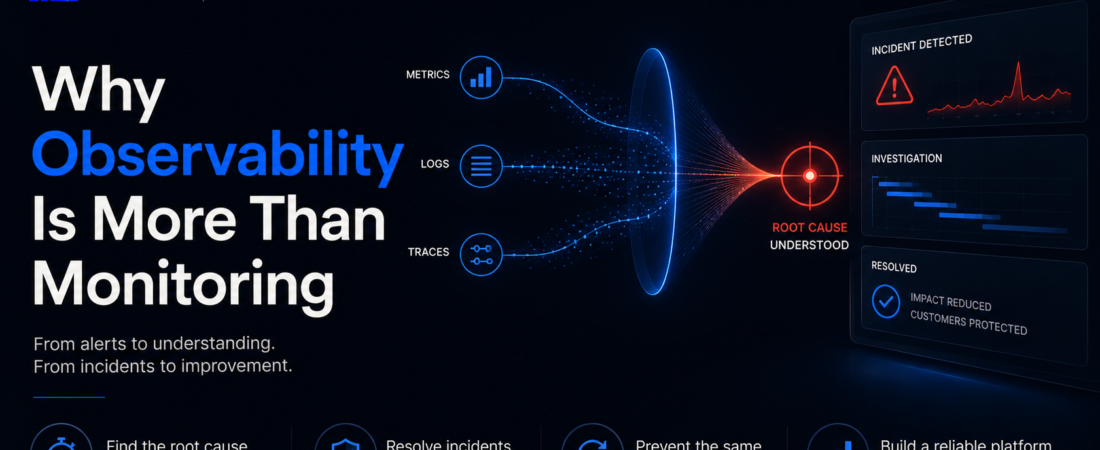
Observability goes beyond collecting metrics.
It connects metrics with logs, traces, and system behavior to reveal the root cause of an incident.
Instead of asking engineers to guess, observability provides the evidence needed to understand what happened.
This reduces investigation time and helps teams make informed decisions during critical incidents.
Why Root Cause Matters
Resolving an incident is only part of the job.
If the underlying cause remains unknown, the same incident is likely to happen again.
Temporary fixes may restore the service, but they do not improve the platform.
Reliable systems are built by identifying and eliminating recurring causes—not by repeatedly responding to the same symptoms.
The Business Impact
Poor observability affects more than engineering teams.
Customers experience longer outages.
Support teams receive more requests.
Engineers spend hours investigating instead of building new capabilities.
Revenue opportunities are delayed.
Trust is reduced every time an incident takes longer than necessary to understand.
The longer it takes to identify the root cause, the greater the business impact becomes.
What High-Performing SaaS Companies Do
Successful SaaS companies invest in understanding their systems, not simply watching them.
They build observability that allows teams to detect problems quickly, investigate efficiently, and prevent similar incidents in the future.
Their goal is not to collect more operational data.
Their goal is to turn operational data into actionable understanding.
Final Thought
Monitoring tells you that something happened.
Observability tells you why it happened.
That difference determines how quickly teams recover, how effectively they prevent future incidents, and how confidently the business can continue to grow.
The most reliable platforms are not those that experience the fewest incidents.
They are the ones that learn from every incident and continuously improve because they understand what their systems are telling them.
Altiprime helps SaaS companies identify and resolve operational, architectural, and scalability bottlenecks before they become growth constraints.
Neil Altawil | Founder & CEO, Altiprime
https://linkedin.com/in/neil-altawil